How Valuable Is the Turkish Passport? Benefits for Investors in 2026
Posted at
Posted on
Investment Guide
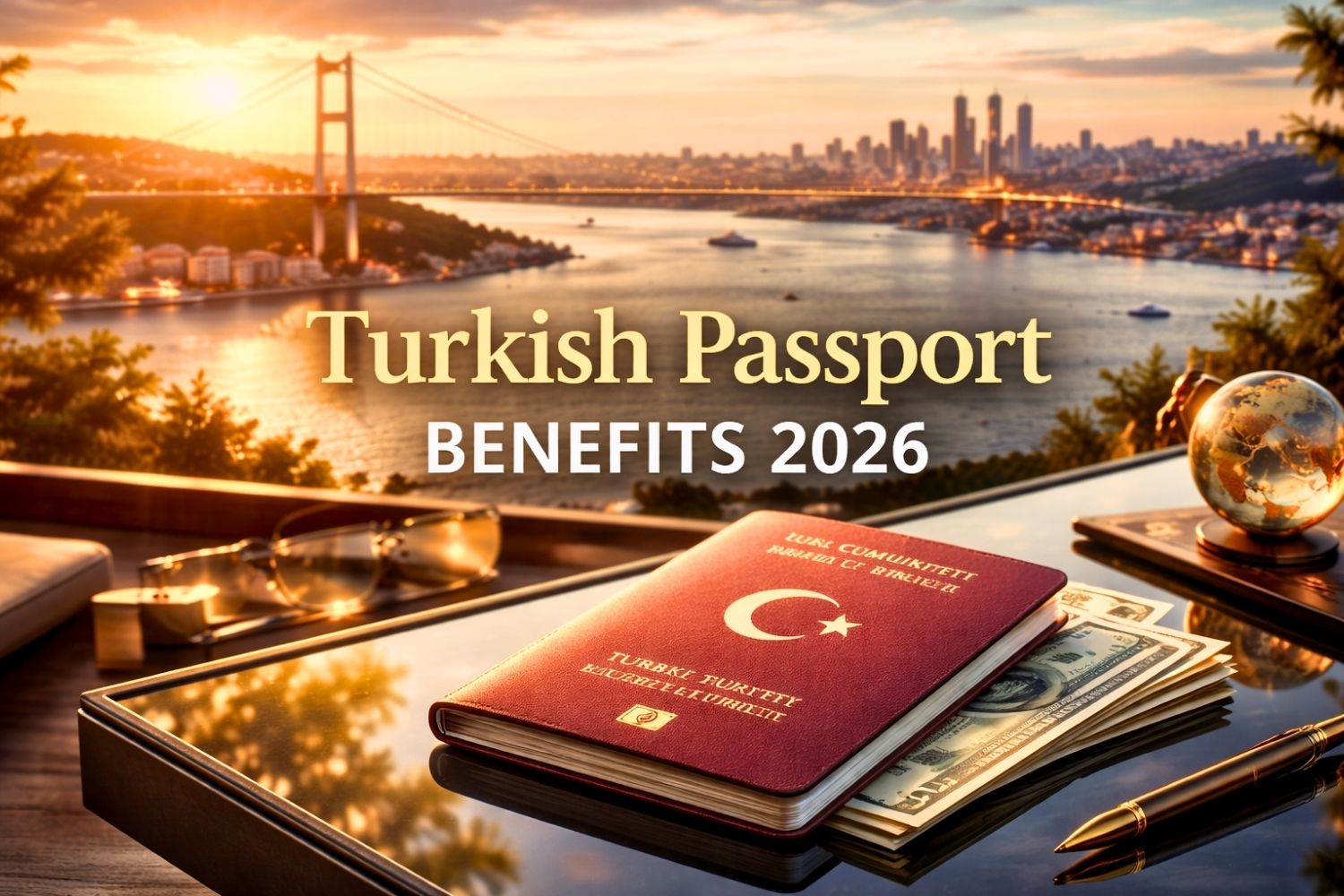
How Valuable Is the Turkish Passport? Benefits for Investors in 2026
For international buyers, a passport is no longer just a travel document. It is a strategic asset connected to mobility, family planning, tax structuring, regional access, wealth preservation, and long-term lifestyle decisions. That is exactly why interest in Turkish citizenship has remained strong among foreign investors, especially those already exploring real estate opportunities in Istanbul. Türkiye’s citizenship-by-investment framework continues to stand out because it combines a relatively accessible real estate entry threshold with a large domestic market, a strategic geographic position, and a passport that offers access to more than 110 destinations without a prior visa according to current passport mobility datasets.
The Turkish passport is especially attractive to buyers who do not want a purely symbolic second nationality. Many investors want something practical: a passport connected to an economy with depth, a globally connected city like Istanbul, legal ownership rights in a major property market, and a process that can include close family. Türkiye’s official investment guidance states that foreign nationals can qualify through the acquisition of real estate worth at least USD 400,000, provided the property carries a restriction against resale for at least three years.
For luxury buyers and globally mobile families, the decision is rarely only about “Can I get a second passport?” The better question is: “Does this passport unlock a bigger strategic plan?” In the case of Türkiye, the answer is often yes. It can be part of a broader investment thesis that combines citizenship, portfolio diversification, lifestyle optionality, family inclusion, and exposure to a market where premium real estate still attracts regional and international capital.
Why the Turkish Passport Is Valuable
The Turkish passport provides several advantages for international investors.
Key benefits include:
• Access to visa-free travel
• A strong real estate investment market
• Strategic geographic location between Europe and Asia
• Citizenship for family members
Turkey also offers one of the fastest citizenship-by-investment programs in the world.
Why the Turkish Passport Matters More Than Many Investors Realize
A strong citizenship proposition usually rests on four pillars: mobility, speed, family inclusion, and investment logic. Türkiye performs well across all four. On mobility, current passport indexes show Turkish passport holders can access more than 110 destinations through visa-free, visa-on-arrival, or similar facilitation routes, which is materially useful for businesspeople and international families. On eligibility, the official real estate threshold remains USD 400,000 with a three-year hold requirement. On family planning, market guidance for the program consistently states that the principal applicant may include a spouse and dependent children under 18.
That combination is why the Turkish passport often appeals to investors from regions where travel friction is a major issue. A passport that expands mobility while also connecting the holder to a G20 economy, a major aviation hub, and a deep property market can create value far beyond leisure travel. It can support business expansion, easier regional movement, educational planning for children, and broader personal optionality. The value is not only in the number of countries accessible, but in how that mobility fits into a larger personal and commercial strategy.
Turkish Citizenship by Investment: Why Real Estate Is the Most Popular Route
Türkiye offers several investment pathways, but real estate remains the route most closely aligned with practical investor behavior. According to the Republic of Türkiye Investment Office, qualifying through property requires acquiring real estate worth at least USD 400,000 or the equivalent in foreign currency and placing a title deed restriction preventing resale for at least three years. Other paths exist, such as bank deposits or fixed capital contributions at higher thresholds, but property remains the most tangible and intuitive option for many international clients.
Real estate is attractive because it is not simply a fee paid to obtain nationality. It is a capital allocation into a physical asset class. For many investors, that matters. They prefer owning an apartment, branded residence, villa, or income-generating unit rather than locking funds into a passive route that feels disconnected from day-to-day utility. In the Turkish model, the investment can serve two goals simultaneously: citizenship eligibility and long-term exposure to a real estate market with rental potential and appreciation upside, especially in globally visible districts of Istanbul.
This is where the Turkish passport becomes especially relevant for luxury real estate advisors. The passport is not sold as an isolated product. It is embedded in a wider proposition: acquire quality real estate in a major international city, secure a second citizenship route, and hold an asset that can still serve personal use, rental yield, resale positioning, or portfolio diversification. That makes the conversation much stronger than a generic migration pitch. It becomes an investment and lifestyle conversation, which is exactly how affluent buyers prefer to engage.
Visa-Free Countries for Turkish Passport Holders
Turkish passport holders can travel visa-free or with visa-on-arrival to more than 110 countries.
Some of the most popular destinations include:
• Japan
• South Korea
• Singapore
• Brazil
• Qatar
• Malaysia
• Thailand
This level of travel freedom makes the Turkish passport attractive for entrepreneurs and international investors.
Countries Turkish Passport Holders Can Visit (2026)
Country | Visa Type |
|---|---|
Albania | Visa Free |
Argentina | Visa Free |
Bahamas | Visa Free |
Barbados | Visa Free |
Belarus | Visa Free |
Belize | Visa Free |
Bolivia | Visa Free |
Bosnia and Herzegovina | Visa Free |
Botswana | Visa Free |
Brazil | Visa Free |
Chile | Visa Free |
Colombia | Visa Free |
Dominica | Visa Free |
Ecuador | Visa Free |
El Salvador | Visa Free |
Fiji | Visa Free |
Georgia | Visa Free |
Guatemala | Visa Free |
Haiti | Visa Free |
Honduras | Visa Free |
Hong Kong | Visa Free |
Indonesia | Visa Free |
Iran | Visa Free |
Jamaica | Visa Free |
Japan | Visa Free |
Jordan | Visa Free |
Kazakhstan | Visa Free |
Kosovo | Visa Free |
Kyrgyzstan | Visa Free |
Malaysia | Visa Free |
Moldova | Visa Free |
Mongolia | Visa Free |
Montenegro | Visa Free |
Morocco | Visa Free |
Nicaragua | Visa Free |
North Macedonia | Visa Free |
Panama | Visa Free |
Paraguay | Visa Free |
Peru | Visa Free |
Philippines | Visa Free |
Qatar | Visa Free |
Serbia | Visa Free |
Singapore | Visa Free |
South Korea | Visa Free |
Thailand | Visa Free |
Tunisia | Visa Free |
Ukraine | Visa Free |
Uruguay | Visa Free |
Uzbekistan | Visa Free |
Venezuela | Visa Free |
Bangladesh | Visa on Arrival |
Cambodia | Visa on Arrival |
Egypt | Visa on Arrival |
Ethiopia | Visa on Arrival |
Laos | Visa on Arrival |
Lebanon | Visa on Arrival |
Madagascar | Visa on Arrival |
Maldives | Visa on Arrival |
Mozambique | Visa on Arrival |
Nepal | Visa on Arrival |
Palau | Visa on Arrival |
Rwanda | Visa on Arrival |
Samoa | Visa on Arrival |
Senegal | Visa on Arrival |
Seychelles | Visa on Arrival |
Somalia | Visa on Arrival |
Sri Lanka | Visa on Arrival |
Tanzania | Visa on Arrival |
Timor-Leste | Visa on Arrival |
Tonga | Visa on Arrival |
Tuvalu | Visa on Arrival |
Bahrain | eVisa |
Benin | eVisa |
Bhutan | eVisa |
Djibouti | eVisa |
Gabon | eVisa |
Guinea | eVisa |
Guyana | eVisa |
India | eVisa |
Iraq | eVisa |
Israel | eVisa |
Kenya | eVisa |
Kuwait | eVisa |
Malawi | eVisa |
Mauritania | eVisa |
Mexico | eVisa |
Myanmar | eVisa |
Namibia | eVisa |
Nigeria | eVisa |
Pakistan | eVisa |
Papua New Guinea | eVisa |
Saudi Arabia | eVisa |
Tajikistan | eVisa |
Vietnam | eVisa |
Zambia | eVisa |
Zimbabwe | eVisa |
Global Mobility: A Practical Advantage, Not Just a Marketing Phrase
One of the most widely discussed benefits of the Turkish passport is travel access. Current passport data indicates Turkish citizens have access to more than 110 destinations without obtaining a full prior visa, including a mix of visa-free, visa-on-arrival, and electronic entry options. Examples visible in current passport datasets include destinations such as Japan, South Korea, Brazil, Qatar, Malaysia, Thailand, Indonesia, Hong Kong, and several countries in Latin America, the Balkans, and parts of Asia.
For investors, mobility should be measured in convenience rather than marketing hype. No serious advisor should present the Turkish passport as equivalent to the very top-tier passports globally. That would be inaccurate. But it is equally wrong to underestimate it. For many families, a passport that materially reduces travel friction across a meaningful list of business and leisure destinations can have real operational value. It improves optionality, supports multi-country planning, and reduces dependence on a single nationality.
This is particularly relevant for entrepreneurs and real estate investors who travel frequently across Europe’s periphery, the Middle East, Central Asia, and parts of Asia. Even where a visa is still required, holding Turkish citizenship can still be strategically useful because it broadens one’s geopolitical and personal positioning. In practice, many investors do not seek a second passport only for a ranking score; they seek resilience, flexibility, and a more diversified future.
Family Inclusion Makes the Program More Attractive
One of the strongest practical advantages in the Turkish citizenship-by-investment model is that the application can extend beyond the principal investor. Guidance from leading program sources consistently indicates that the spouse and dependent children under 18 can be included in the same investment-based citizenship file. That changes the economics of the decision dramatically. A real estate purchase is not just creating an outcome for one person; it can secure a broader family position.
For many affluent families, this is one of the decisive factors. They are not only comparing passport rankings. They are comparing how efficiently a program serves the household. Can the spouse also benefit? Can children be included? Is the structure clear? Is the route predictable? On these questions, Türkiye remains competitive because the family dimension is straightforward enough to be commercially understandable while still tied to a real asset.
There is also a lifestyle layer to this. A second citizenship that covers the immediate family can support education planning, future relocation flexibility, inheritance structuring, and residence choices. For luxury buyers looking at Istanbul, this is often part of a wider long-term strategy rather than a short-term transaction.
Benefits of Turkish Citizenship for Investors
Investors choose Turkish citizenship for several reasons:
• Dual citizenship allowed
• Access to Turkish banking system
• Business opportunities in a growing economy
• Access to healthcare and education
• Strategic location for international business
Turkey’s economy and real estate market continue to attract global investors.
Why Investors Often Prefer Türkiye Over More Expensive Programs
Not every citizenship or residency route works for every buyer. Some European pathways are slower, more expensive, or more uncertain. Some routes are residency-led rather than citizenship-led. Others require a longer timeline before the investor sees the full personal benefit. Türkiye occupies a compelling middle ground: the threshold for the real estate route is officially USD 400,000, the asset is tangible, the hold period is three years, and market participants continue to describe the overall process as relatively fast compared with many alternatives.
That does not mean buyers should treat the process casually. Due diligence, valuation compliance, banking documentation, title deed procedures, and the legal structure of the transaction all matter. But from a positioning perspective, the Turkish program remains attractive because the investment threshold is understandable, the route is well known internationally, and the asset itself can be selected based on investment logic rather than just legal compliance. Investors can target areas with better rental liquidity, stronger resale profiles, or more defensible luxury branding.
This matters for premium clients. Sophisticated buyers do not want to purchase “just any unit” to tick a citizenship box. They want the passport and the property to both make sense. That is where an advisor like Motelle Property can create real differentiation by filtering for location quality, project credibility, exit potential, and lifestyle fit.
Why Istanbul Is the Top Choice for Foreign Investors
Istanbul is Turkey’s largest city and its economic center.
Investors choose Istanbul because of:
• strong rental demand
• luxury residential developments
• international lifestyle
• long-term property appreciation
Luxury districts such as Beşiktaş, Şişli, and Sarıyer are particularly popular among international buyers.
Why Istanbul Strengthens the Value of Turkish Citizenship
The Turkish passport becomes even more interesting when paired with Istanbul. Istanbul is not only Türkiye’s largest city; it is also its commercial engine, its best-known international real estate market, and one of the few cities globally that naturally sits between Europe and Asia. That geographic reality strengthens both the real estate case and the citizenship case. The same investment that can support citizenship eligibility can also place the buyer inside a market with deep domestic demand, significant international recognition, and a broad range of luxury inventory.
For foreign investors, Istanbul offers different strategic profiles depending on district and property type. A Bosphorus-facing home appeals to lifestyle-led wealth. A branded residence in Şişli or Beşiktaş may serve both prestige and urban convenience. Business-oriented investors may prefer nodes connected to commercial activity and premium rental demand. Buyers targeting long-term capital preservation often prioritize established, recognizable districts where international demand is likely to remain deeper over time.
That is why content about Turkish citizenship should not live in isolation from content about Istanbul real estate. From an SEO perspective and a conversion perspective, they belong together. A user searching “Turkish passport benefits” is often one or two steps away from searching “best property for citizenship in Istanbul” or “luxury real estate in Istanbul for foreign investors.” Your site should be designed to capture that progression.
Is the Turkish Passport Mainly About Travel, or Is It About Investment Strategy?
The smartest way to answer this is: both, but the investment layer is what makes the Turkish proposition distinctive. Plenty of buyers are initially attracted by travel convenience. But what often closes the deal is the realization that the route is backed by a real estate asset rather than a pure sunk cost. The official framework does not ask the investor to donate money and walk away empty-handed; it allows the purchase of qualifying real estate that can be held for the required period and then managed as part of a broader portfolio.
This opens up several strategic possibilities. Some buyers choose a property primarily for citizenship compliance and capital safety. Others want stronger rental income. Some want a pied-à-terre in Istanbul while preserving optionality for resale after the hold period. Others seek a family residence that doubles as a citizenship solution. The passport’s value therefore cannot be separated from the investment quality of the asset chosen to obtain it.
That is also why bad property advice can damage the overall value proposition. A weak asset may still qualify legally, but it can undermine the investor financially. A strong asset, by contrast, enhances the entire package. It is not just “citizenship obtained”; it is “citizenship obtained through a sensible luxury real estate acquisition.”
How to Get Turkish Citizenship Through Real Estate
Step 1
Choose an eligible property worth at least $400,000
Step 2
Complete the property purchase
Step 3
Apply for citizenship
Step 4
Receive Turkish passport
The entire process can take between 3 and 6 months.
Risks Buyers Should Understand Before Applying
A high-quality article should not romanticize the process. There are real risks if investors move too fast or rely on unqualified intermediaries. The property must satisfy the legal threshold, the title deed process must be handled correctly, and the no-sale annotation for the required period must be placed properly. Official guidance also makes clear that the purchase must fit the qualifying legal framework, which means transaction execution matters.
Another risk is asset selection. Some investors focus so heavily on obtaining the passport that they neglect rental fundamentals, district quality, project reputation, and future liquidity. That is short-sighted. Citizenship is important, but the underlying property still needs a rational investment case. Poorly chosen stock can make resale difficult, suppress yield, or create avoidable legal and management headaches.
A third risk is relying on outdated assumptions. Rules, procedures, and travel access can evolve over time. Investors should therefore treat any article, including this one, as a strategic guide rather than a substitute for transaction-specific legal advice. The best approach is always to combine current legal verification with disciplined property due diligence.
Who Is the Turkish Passport Best Suited For?
The Turkish passport is especially compelling for four buyer profiles. First, foreign investors who want citizenship through a real estate-backed route rather than a donation-style program. Second, families who value including a spouse and dependent children under one investment umbrella. Third, entrepreneurs and internationally active professionals who benefit from improved mobility and a stronger regional base. Fourth, luxury buyers who already see Istanbul as a serious lifestyle or investment market and want their property purchase to create an additional legal benefit.
It may be less compelling for buyers whose only priority is access to the absolute top tier of global visa-free travel. In that case, other passports may rank higher. But that is not the only lens that matters. For many investors, Türkiye offers a better balance of cost, speed, family coverage, market depth, and asset-backed logic than programs that look better on a ranking table but do less in practice for the investor’s broader portfolio.
Final Verdict: How Valuable Is the Turkish Passport in 2026?
In 2026, the Turkish passport remains valuable not because it is the world’s highest-ranked passport, but because it delivers a strong balance of practicality and investment logic. It offers access to more than 110 destinations without a prior visa, connects the holder to a major economy and one of the world’s most strategically located cities, and can be obtained through a qualifying real estate investment of at least USD 400,000 with a three-year hold requirement. For many investors, that mix is compelling.
For buyers already considering Istanbul, the value becomes even clearer. Instead of treating citizenship and property as two separate decisions, they can structure one move that supports both. That is why the Turkish passport continues to attract international investors, especially those who think beyond short-term travel and focus on long-term optionality, family planning, and strategic asset ownership.
If you are evaluating Turkish citizenship through property, the right question is not only whether the passport is valuable. It is whether you can secure that passport through the right property. In luxury real estate, asset quality determines whether the citizenship route feels merely acceptable or genuinely intelligent.
Private Advisory for Luxury Buyers
At Motelle Property, we help international clients identify premium Istanbul properties that align with both citizenship eligibility and investment quality. That means focusing not only on the legal threshold, but also on location strength, district profile, long-term resale potential, and luxury market positioning.
Turkish Citizenship by Investment Program
One of the fastest ways to obtain a Turkish passport is through the Citizenship by Investment Program.
The most popular route is real estate investment.
Requirements:
• Minimum property investment: $400,000
• Hold property for 3 years
• Citizenship approval usually within 3–6 months
Real Estate Investment: The Fastest Path to Turkish Citizenship
Many international buyers obtain Turkish citizenship through real estate investment in Istanbul.
Luxury properties in Istanbul not only qualify investors for citizenship but also offer strong rental income and long-term appreciation.
Explore premium investment opportunities with Motelle Property.
FAQ
Is the Turkish passport powerful?
Yes. The Turkish passport allows visa-free or visa-on-arrival access to more than 110 countries.
How much investment is required for Turkish citizenship?
Foreign investors can obtain Turkish citizenship by purchasing real estate worth at least $400,000.
How long does it take to get Turkish citizenship?
The process typically takes 3 to 6 months.